
THE ARCHIVAL IMPERMANENCE PROJECT
How do classic films remain alive and authentic amidst the shifting sands of time,
societal upheaval,
and technological advance?
THE ARCHIVAL IMPERMANENCE PROJECT is a unique work integrating detailed film restoration case studies from the dawn of cinema to present day, in the framework of an organic theory of practice. Growing from the multi-decade career of award-winning restorationist / filmmaker Ross Lipman, it compiles a diverse assembly of essays, lectures, and rare archival documents. Accompanied by copious illustrations and in-depth appendices, it is destined to be an invaluable resource to a wide range of scholars and archivists. An additional section of historical essays on classic films restored by the author illuminates the ways in which archival work enables new understandings of canonical titles, inviting a wide range of cinephiles and movie lovers to the fruits of this specialized field.
Together, the book’s diverse components propose a new way of looking at the act of film restoration within a context of the only known condition of life: impermanence itself.
buy the book at a discounted price directly from STICKING PLACE BOOKS
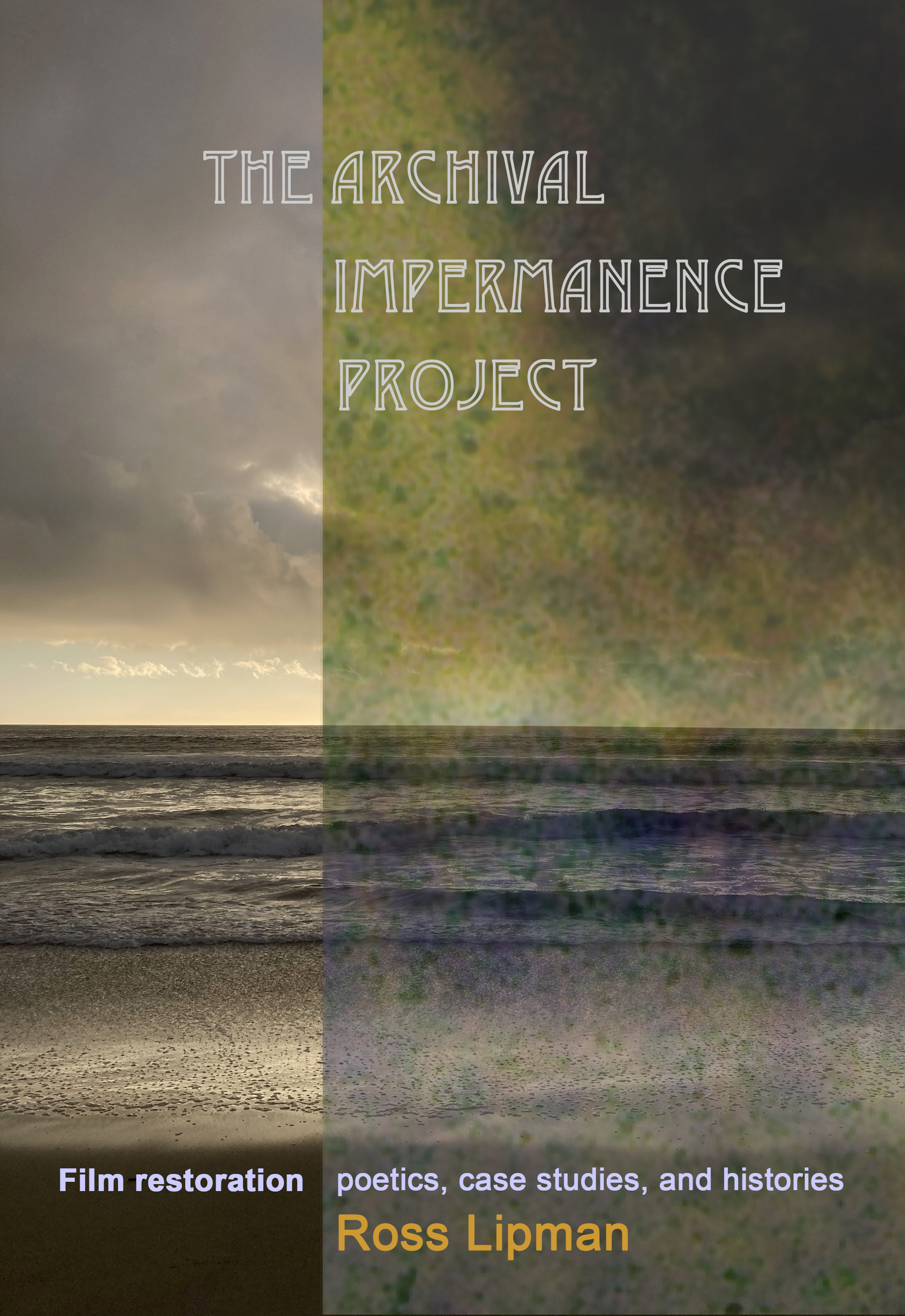
The Archival Impermanence Project: Film Restoration Poetics, Case Studies, and Histories
"Acclaimed film restorationist and independent filmmaker Ross Lipman has spent decades thinking about film as both a material artifact and an artistic medium. In these nimble, intellectually daring essays, he takes us on a journey through that lifetime of experience, stopping along the way to consider everything from the proto-cinematic photography of Eadweard Muybridge to the myriad distractions of 21st-century home viewing. In its own unassuming, at times playful way,
The Archival Impermanence Project sets out to propose nothing less than a new philosophy of the archive for the post-digital era."
— Dana Stevens, Slate
"A truly bountiful treasure chest bringing together Ross Lipman’s restoration writings, research, analysis, imagination, and enjoyment; all of them slyly educating one another, spurred by an indefatigable curiosity. His remarkable essay on Cassavetes and Mingus is the best and most useful thing I've ever read about either artist. I can't really praise it too highly."
— Jonathan Rosenbaum, Sight and Sound
"The book is witty, minutely detailed, and braced by common sense — a welcome gift in an often obsessive environment. If you have any interest in the collision of old and new, in any field of endeavor—architecture, archeology, sexuality, table manners—I recommend a particular chapter of Lipman’s book, ‘The Gray Zone.’ Lipman is graced with a talent to enthuse."
— Anthony Lane, The New Yorker
“The Archival Impermanence Project manages to resist even the seeming fixity of the printed word as it moves chronologically through Lipman’s inimitable career. As essays in the truest sense, each case study works to ground the field-defining ethical and aesthetic quandaries he has been exploring for the better part of two decades in the practical terms of specialized labor. All over, his descriptions highlight indeterminacies: language of the ephemeral, the phantasmagorical, the flickering, and the nebulous abounds. And yet there’s no loss of clarity, only an invitation to look, to read and interpret, more closely. More than anything, The Archival Impermanence Project demands that we, as lay audiences or professional interpreters, attend to our own attending; that is, that we see our own seeing.” - Jadie Stillwell,
The Brooklyn Rail
“The Archival Impermanence Project explores in detail the decision-making and technical processes behind many of Lipman’s landmark projects and provides a much-needed meta-analysis of the film preservation discipline, outlining a series of questions about the nature of archives, the ephemerality of cultural objects, and the history of cinematic technology. Far from a technical manual, however, the book is buoyed throughout by Lipman’s quirky voice, humorous anecdotes, and insider trivia. This fascinating anthology makes clear that it is the process of film restoration, in its constant consideration of authenticity, materiality, and artistic vision, that is uniquely positioned to address the paradox of archival impermanence.”
- Lily Grossbard,
Film Comment
Essential Film, Music and Culture Books of 2025
- Kier-La Janisse,
Spectacular Optical